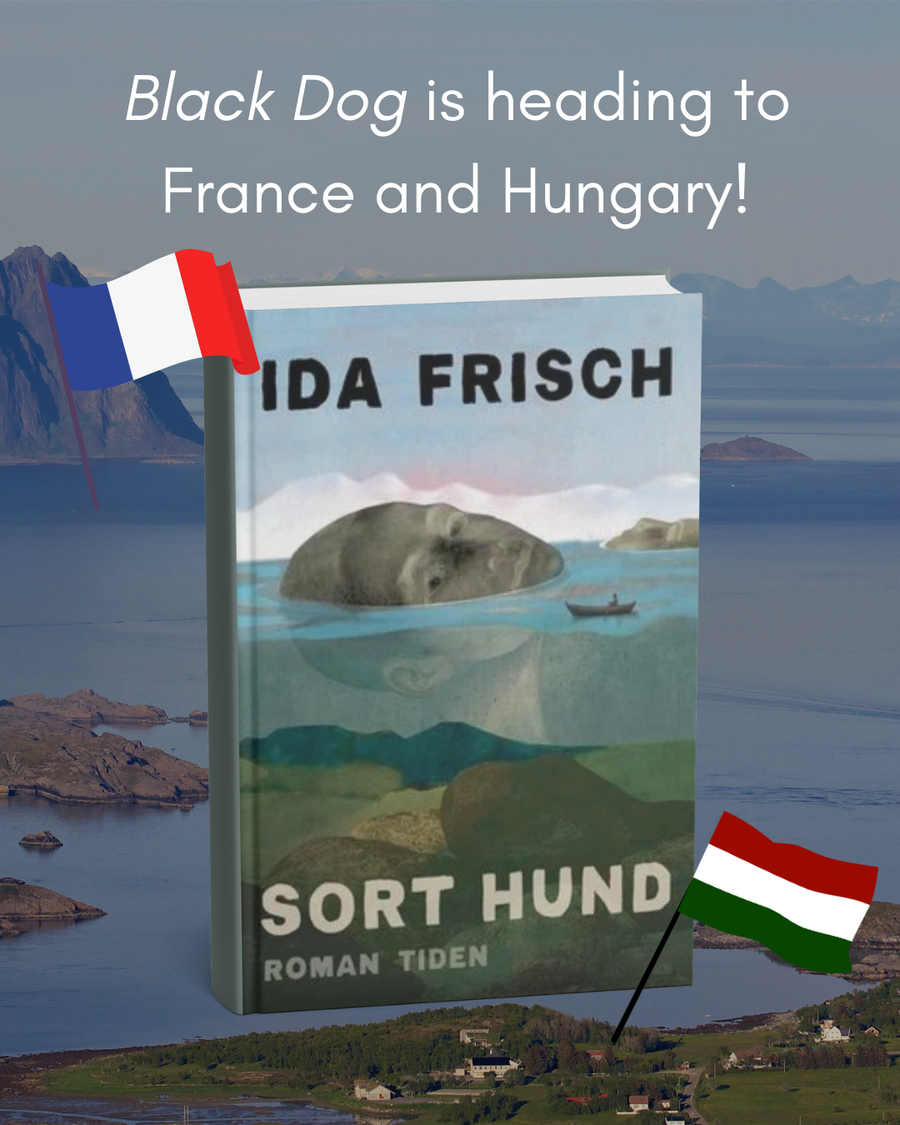
"Black Dog" sold to France and Hungary
It looks like 2026 is going to be a big year for Ida Frisch! Her breakout novel, Black Dog (Sort hund, Tiden Norsk Forlag 2025), is heading to France and Hungary!
After an intense bidding round, Aurélie Charron, commissioning editor at Éditions Paulsen, is thrilled to be bringing the book to French readers:
“Ida Frisch’s powerful voice brings the island’s landscapes to life. Through her visionary narrator, who can see what others cannot, and chooses, against the tide of history, to live freely in this untamed landscape and reject the alienation of factory life, Ida Frisch creates a symbol of passive resistance and celebrates our sense of belonging.”
Zsófia Dériné Stark, founder and editor of Polar Könyvek, has written a veritable love letter to Ida:
“Black Dog is not only a powerful and haunting Nordic novel for me, but also a mirror. It opens a world that is geographically and culturally far removed from us as Hungarians — from the wide, sunburnt plains of the Hungarian Great Plain, from the heat, dust, and flat horizons that shape our own rural imagination. It takes us instead to a wind-beaten island at the edge of a fjord in Western Norway, where cold, sea, faith, and physical labor define the rhythm of life. And yet, while reading, I constantly felt: this story is also ours.
If the same fate were set on the Hungarian Great Plain, in a remote farmhouse under the burning summer sun, everything on the surface would be different — but the inner structures would remain strikingly similar. The silences, the unspoken trauma, the strict and emotionally distant father, the self-sacrificing female role, the young person longing to escape, and the inherited fear that finds expression in faith and superstition: these patterns feel painfully familiar, whether they grow out of northern winds or southern dust.
The world of the Norwegian island — the slaughtering of lambs, the drying of fish, the harsh daily routines, the constant presence of the sea — may seem exotic at first. But step by step it becomes clear that this is not a novel about landscape, but about human endurance. About how a family goes on after an unspeakable loss, how a child grows up too fast, and how the “black dog” becomes a living symbol of grief that is never fully spoken.
This is why Black Dog is so important to me. It shows that the deepest human patterns are not Nordic or Central European, not shaped by fjords or by the Hungarian plains, but shared. The story is at once foreign and intimately familiar. And this, to me, is one of the true powers of literature: to begin in a distant world and still speak directly about us."
The book is also under offer in Greece, which will mark the fifth international sale for this beautiful novel.
Congratulations, Ida!